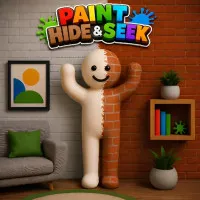
In most hide-and-seek games, your only asset is location. Paint Hide & Seek gives you a second one: appearance. Finding the right corner still matters, but painting yourself to match it - and posing convincingly once you're there - is what actually determines whether the seekers walk past or stop and look twice.
Disguise First, Location Second
Traditional hide-and-seek logic says: find the best spot, stay still, don't make noise. Paint Hide & Seek keeps the "stay still" part and throws out most of the rest. Location is a starting condition, not a solution. A well-painted player standing in an open area can be completely invisible. A player who rushed to a good corner but didn't match the colors around them gets found immediately.
This inverts the skill tree. The players who understand Paint Hide & Seek fastest are the ones who stop looking for dark corners and start studying the environment they're in - what colors dominate it, what shapes are nearby, what a convincing version of that wall or that object would actually look like.
How Rounds Play Out
Each round splits players between hiders and seekers. Hiders get a window of time to find a position, activate paint mode, choose their colors, and select a pose before seekers start searching. That window is the most important phase of the game - everything that determines whether you survive happens before the seekers enter the space.
Paint Hide & Seek shifts the pressure onto preparation rather than reaction. The hiding phase requires active decision-making: where am I, what do I look like here, and what pose makes this believable? Rushing through any of those decisions leaves a visible gap that a careful seeker will catch.
Controls
WASD / Arrow Keys - move around the map
Mouse - control camera rotation
Spacebar - jump
F - activate paint mode to change your appearance
T - choose your pose
The Pose Is Half the Disguise
Color alone doesn't make a convincing disguise. A player painted to match a wall but standing upright in front of it still has the silhouette of a standing player. The pose has to match the environment's geometry - lying flat against a floor surface, pressing into a corner at an angle, mimicking the shape of the object you're blending into.
The best hiders in Paint Hide & Seek treat color and pose as a single decision, not two separate ones. They choose a location that has both a matching color palette AND a shape that their available poses can plausibly mimic. The whole thing either works together or it doesn't.
What Keeps Each Round Fresh
No two rounds play out the same way because player choices are too unpredictable. As a seeker, you're not looking for people in corners - you're looking for things that seem slightly wrong. A texture that doesn't quite match its surroundings. A "box" that has slightly different proportions than the real ones nearby. The longer you play Paint Hide & Seek as a seeker, the more you develop an instinct for wrongness rather than a checklist of places to check.
Switching between hider and seeker roles keeps both sides interesting. Skills built while seeking teach you where the gaps in disguises tend to appear. Skills built while hiding teach you what seekers look for first.
The puzzle doesn't end here - Robber Run rewards the same patient, observation-driven mindset, and Hide And Seek Online keeps the cat-and-mouse tension going from a different angle.