
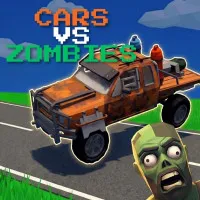
Cars vs Zombies


























Cars vs Zombies
What Is Cars vs Zombies?
Cars vs Zombies is a free arcade vehicular survival game where you drive armored cars through zombie-packed arenas, collect scrap from every enemy you crush, and spend it in the garage on upgrades that visually transform your vehicle into something progressively more dangerous-looking with every improvement. Three vehicles. Four maps. Endless waves of undead that get denser and faster the longer you survive.
Developed by Holystick Games and released in May 2026, the game combines the satisfaction of vehicle combat with a resource loop that makes every run feel productive even when it ends early. Scrap collected during failed runs still funds the upgrades that make the next run stronger - which means no session, however short, leaves you exactly where you started.
How Cars vs Zombies Works
Each arena drops your vehicle into a closed environment populated with zombie waves that appear in increasing numbers and density. Your car is both your weapon and your only protection - ramming through clusters crushes enemies and generates scrap pickups, while mounted weapons handle threats at range before they surround you completely.
The interactive environment adds a tactical layer beyond pure wave survival. Arena objects can be destroyed and manipulated to clear paths, create chokepoints, or eliminate zombie clusters without direct contact. Learning which environmental elements work in your favor on each of the four maps turns the arena from an obstacle into a tool.
The core loop in Cars vs Zombies runs on three systems working simultaneously:
- Movement - staying mobile is survival; stopping creates the surrounded situations that end runs fastest
- Scrap collection - every crushed zombie drops resources that fund garage upgrades between sessions
- Wave reading - zombie spawn patterns and density shifts follow recognizable timing that rewards anticipation over reaction
Health, ammo, and power-ups respawn on a clock across all four maps. Timing these respawns keeps you consistently topped up through longer runs rather than scrambling for resources during heavy wave encounters.
Vehicles, Upgrades, and the Garage
The garage system in Cars vs Zombies covers every performance and protection variable that affects survival length:
- Engine and speed upgrades - increases base movement rate and acceleration out of surrounded situations
- Attachable armor - reduces damage from direct zombie contact and environmental collisions
- Mounted weapon improvements - increases damage output and fire rate against dense wave clusters
- Boosters - provides burst escape capability during heavy encounters where normal movement speed isn't enough
What separates the upgrade system visually is that improvements don't just change numbers - each upgrade tier changes how the vehicle looks. A stock car at the start of the game looks recognizably stock. A fully upgraded vehicle looks like something built specifically for a zombie apocalypse, with visible armor plating, mounted weaponry, and an overall profile that reflects the investment made into it. The visual progression gives the garage a reward beyond pure stat improvement.
Three distinct vehicles are available, each with different base handling and weapon configurations that suit different playstyles across the four arena maps. Heavier vehicles absorb zombie contact more efficiently but respond slower in tight situations. Lighter configurations cover ground faster but require more precise positioning to avoid being overwhelmed from multiple directions simultaneously.
Four Maps, Four Environments
Each of the four arenas in Cars vs Zombies introduces distinct terrain layouts and environmental interaction possibilities that change how waves are best approached:
The map variety means strategies developed on one arena don't transfer automatically to another. Chokepoints that work in tight urban layouts don't exist on open terrain maps. Environmental objects available for destruction differ between locations. Learning each map's specific advantages - and which vehicle handles its layout most effectively - is a secondary progression layer that extends the game well beyond the upgrade tree.
Game Controls
Cars vs Zombies uses a dual-input control scheme that separates movement from combat.
- WASD - drive and maneuver the vehicle
- Shift - nitro boost the vehicle
- Mouse - aim mounted weapons
- Left Click - fire
The separation of driving and aiming controls is the core skill of the game. Moving efficiently while maintaining accurate aim on approaching zombies requires building independent muscle memory for each input. Most players find the controls click within the first minute - the strategic layer of when to move versus when to commit to firing takes longer to develop.
Tips to Survive Longer in Cars vs Zombies
Longevity in Cars vs Zombies comes from movement discipline and resource timing rather than raw combat performance:
- Never stop moving. A stationary vehicle gets surrounded faster than any other mistake. Strafe continuously even while firing - circular movement around zombie clusters keeps escape routes open and prevents the flanking that ends most runs.
- Prioritize scrap collection over kill efficiency. Driving through zombie clusters crushes multiple enemies simultaneously and generates scrap faster than targeted weapon fire. Use mounted weapons for threats that can't be reached by vehicle contact, not as the primary kill method.
- Learn power-up respawn timing on each map. Health and ammo respawn on a consistent clock across all four arenas. Timing your route to pass respawn locations when they're ready keeps resources topped up without diverting from the wave engagement.
- Use the environment before using ammunition. Destructible and interactive arena objects eliminate zombie clusters without consuming ammo. Identifying which environmental elements are available on each map and using them early in a run preserves weapon resources for the heavier wave encounters in later stages.
- Upgrade armor before weapons in the garage. Armor improvements reduce the damage accumulation that ends runs in the mid-game. A vehicle that survives longer generates more scrap per session than a fragile high-damage build that dies before the heaviest waves arrive.
The central trade-off in Cars vs Zombies is between aggressive wave engagement that maximizes scrap generation and conservative positioning that preserves vehicle health for longer survival. Aggressive runs generate more upgrade resources per session. Conservative runs reach later wave stages more consistently. The most effective approach combines both - pushing into clusters for scrap during manageable waves and pulling back to create space when density increases beyond comfortable engagement range.
Cars vs Zombies is a game where the vehicle you start with and the vehicle you're driving after a few garage sessions feel genuinely different - in performance, in appearance, and in how confidently you can push into the next wave. The zombies keep coming. The only question is how far the upgrades carry you before they do.

























Cars vs Zombies