
Draw Action




Draw Action
What Is Draw Action?
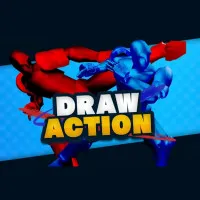
Draw Action is a free gesture-based fighting game where the attack you perform depends entirely on the pattern you draw - sketch a line across your fighter's arm to throw a punch, trace a shape on their leg to deliver a kick, or combine both to chain a combo that sends enemies flying off the platform into the water below. No buttons, no preset movesets. Your drawing is your weapon.
Developed by Eccentric Studio, the game sits at an unusual crossroads of action, puzzle, and arcade design. Each level presents a simple objective - defeat every enemy - but the path to getting there involves reading how enemies are positioned, choosing which limb to draw on, and deciding whether to whittle down health bars directly or maneuver opponents toward the edge for an instant environmental kill. Most players notice within the first few levels that the fastest solution and the safest solution are rarely the same thing.
How Draw Action Works
Each encounter puts your blue fighter against one or more enemies on a platform surrounded by water. To attack, tap on your character's arm or leg and draw a pattern. The shape and direction of your drawing determines what kind of strike executes - a short sharp line produces a fast hit, while a longer sweeping pattern generates a heavier attack with more knockback.
Two win conditions exist in every level:
- Reduce the enemy's health to zero through repeated strikes and combo chains
- Push the enemy off the platform into the water for an immediate kill regardless of remaining health
The second option is almost always faster - but it requires precise positioning and enough knockback in your attack pattern to carry them over the edge without leaving your own fighter exposed. Most early levels teach you the first method. Most experienced players switch to the second the moment they understand how knockback scales with drawing momentum.
As levels progress, enemies hit harder, move faster, and appear in larger numbers. The upgrade system becomes essential rather than optional at this point - improving your character's stats between levels unlocks more powerful combo attacks and increases the damage and knockback of your drawing patterns.
The Drawing System - Patterns, Limbs, and Combos
The mechanic that separates Draw Action from standard fighting games is that your attack vocabulary grows with your creativity and your upgrades simultaneously.
Drawing on different limbs produces different attack types. Combining limb inputs in sequence chains those attacks into combos, which deal significantly more damage and knockback than individual hits. Early combos are simple two-step chains. Later upgrades unlock longer sequences that can clear groups of enemies or guarantee an edge push from a single well-drawn combination.
What makes the system tactically interesting in practice:
- The same pattern hits differently depending on limb - a sweeping draw on an arm produces horizontal knockback, while the same pattern on a leg generates more vertical force
- Combo timing matters as much as combo content - drawing the second pattern too slowly breaks the chain and resets damage scaling
- Positioning before drawing changes outcomes - the same attack pattern that knocks a centered enemy back safely sends one near the edge straight into the water
After a few levels, the drawing stops feeling like a gimmick and starts feeling like a language. You develop instincts for which patterns produce which outcomes, and the puzzle layer of the game opens up as you start engineering specific results rather than just attacking and hoping.
Game Controls
The control scheme is built entirely around the drawing mechanic, keeping input as direct as possible.
- Tap on arm or leg - select the limb to draw on
- Draw a pattern - execute the corresponding attack
- Chain patterns across limbs - build combo sequences for increased damage and knockback
The game works on both mouse and touchscreen input. Desktop players using a mouse have slightly more precision on longer pattern draws, while touchscreen input on mobile feels more natural for quick tap-and-swipe combos.
Tips to Win Faster in Draw Action
Clearing levels efficiently comes down to reading enemy positioning and choosing the right attack approach before you draw:
- Prioritize edge kills over health attrition. Pushing an enemy into the water ends the fight instantly regardless of their health bar. If an enemy is within two steps of the edge, focus on knockback patterns rather than damage patterns.
- Upgrade knockback stats first. In early and mid-game levels, the ability to push enemies off the platform is more valuable than raw damage. Knockback upgrades make edge kills reliable rather than lucky.
- Draw slower for heavier attacks. Fast short strokes produce quick light hits. Slower, longer draws generate more force. When you need a single powerful knockback, slow your drawing motion down deliberately.
- Chain arm then leg for the most reliable combos. Most of the core combo sequences in Draw Action reward alternating between arm and leg inputs. Starting with an arm hit to stagger the enemy, then following with a leg pattern for knockback, is the most consistent combo structure across different enemy types.
- Watch enemy movement before drawing. Enemies that are actively advancing toward you have forward momentum that reduces your effective knockback. Wait for them to pause or step back before committing to a push attempt near the edge.
The consistent trade-off in Draw Action is between speed and control. Drawing faster produces more attacks per second but sacrifices the precision that makes combos chain correctly and knockback land at the right angle. Players who slow down slightly and draw with intent consistently outperform players who rush through patterns and break their own combo chains.
Draw Action is a game where your hands are the tactics. The enemies scale, the levels get harder, and the platform gets more crowded - but the drawing system keeps giving you new combinations to discover every time you upgrade and return to the fight.


Draw Action