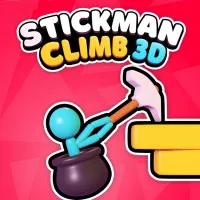
Stickman Climb 3D doesn't let you jump. Every gap between you and the next platform has to be closed with a swinging pickaxe and a willingness to trust physics you don't fully understand yet. The course doesn't care how many times you fall - and neither does the game.
When the Pickaxe Is Your Only Engine
Most platformers give you legs. Stickman Climb 3D gives you a pickaxe and makes you figure out the rest. The tool hooks into surfaces and your body swings from it - pendulum-style, physics-governed, with your next landing entirely dependent on when you let go. This is not a game about jumping. It's a game about arcs.
Once that clicks, the obstacle courses start to make sense. The spikes and crumbling ledges aren't there to punish fast movement - they're there to punish movement at the wrong angle. Every section is a momentum puzzle. The correct solution leaves you balanced on the next platform. The wrong one sends you back to the checkpoint you were so relieved to reach minutes ago.
How to Play Stickman Climb 3D
Your goal in each level is to guide the stickman to the checkered flag waiting at the top. The pickaxe is your sole locomotion tool - swing it into walls and platforms to generate movement, collect coins scattered across the course to unlock outfits and equipment, and reach checkpoints whenever you find them. Coins fund cosmetic upgrades that don't affect difficulty, so the secondary goal never competes with the main one.
Stickman Climb 3D also features a 2-player local mode, where both players share the same keyboard and work through the same course simultaneously - fighting for the same narrow platforms, needing to coordinate swings that would conflict if mistimed. The course gets more complex across levels. Early stages teach you the swing. Mid-game introduces slippery ice, swinging axes, and terrain that collapses under weight.
Controls
1-Player: Drag the mouse left and right, or use the left and right arrow keys
2-Player - Player 1: A and D keys
2-Player - Player 2: Left and right arrow keys
The Habit That Gets Most Players Killed
The hardest thing to unlearn in Stickman Climb 3D is speed. More swinging means more force, and more force feels like progress - until a narrow ledge cuts it short or a crumbling platform collapses before you land. The game is slower than it looks, and the players who go furthest are the ones who pause at checkpoints, read the next section, and commit to a swing only when they understand the arc.
The 2-player mode raises the stakes further. Both players move simultaneously on courses built for one stickman's width. A misread swing from one player can knock the other off a platform they spent three minutes reaching. That shared consequence either creates excellent teamwork or memorable chaos - sometimes both in the same run.
What the Coin System Actually Does
Stickman Climb 3D uses coins to unlock cosmetic rewards: outfits, container styles, and upgraded climbing equipment that changes how things look without changing how physics work. The distinction matters. The difficulty progression is clean - you get harder because the course gets harder, not because of gates or paywalls. Every attempt at a difficult section is an attempt at understanding it, not grinding resources to brute-force past it.
That design keeps the loop honest. You fail, you try again, and eventually the platform that seemed impossible reveals the angle it was waiting for you to find.
Trust the arc and keep the swings deliberate -Getting Over It brings the same unforgiving climb from a different angle, andStickman Climb offers a faster route up when you want less physics and more pace.