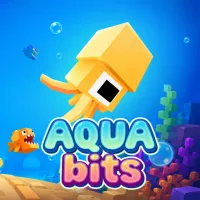
Aqua Bits starts you off as the smallest thing in the ocean and asks a deceptively simple question: can you become the biggest? Every fish you eat adds to your size - and every size increase draws the attention of something larger, faster, and far more dangerous than whatever was chasing you a moment ago.
Growth Is an Escalation Notice
In most fish games, size means safety. Aqua Bits reframes that immediately. Every time you eat enough to evolve, the ocean recalibrates around your new form. New predators appear that match your new scale. New zones open that carry new threats. The evolution system never gives you a moment to breathe - it hands you a fresh category of danger along with every upgrade in size. Players who treat growth as a finish line get caught by what they just graduated into. The ones who last are the ones who already have their next escape route planned before the evolution animation finishes.
How to Play Aqua Bits
The goal is evolution, but the path is survival. You begin as a small fish in open water and navigate toward prey your current size can safely consume. Eating fills an evolution meter, and hitting the threshold grows your fish into the next form, opening new parts of the ocean while exposing you to a new predator tier. The game doesn't pause during evolution - whatever was approaching before the transition still closes in after it. The rhythm is hunt, avoid, grow, adapt, and repeat until something finally catches you. Each run pushes further than the last.
Controls
Aqua Bits runs on a single input: drag the mouse to guide your fish through the water. Direction follows your cursor continuously, which means the game's full depth lives in positioning and route decisions rather than any button complexity. Moving toward prey is easy to learn. Knowing which direction to move when a predator is already entering the screen from two sides at once - that's what the learning curve is actually about. The control is frictionless by design, so nothing stands between your instincts and the ocean.
The Loop That Never Quite Resolves
The tension Aqua Bits sustains comes from scale asymmetry. You are never the apex predator for long. No matter how large you grow, the ocean always has one more creature that treats your current form as lunch. That constant recalibration creates a loop that's genuinely hard to exit. Each evolution feels like an achievement until the next threat appears, at which point survival mode resets and everything accelerates again. Aqua Bits uses this cycle to build the kind of pull that's difficult to name but easy to feel - the sense that you're always one evolution away from finally being safe, knowing the ocean won't let you get there.
Reading the Water Before It Reads You
Players who survive long runs in Aqua Bits develop a specific kind of spatial awareness. The ocean isn't arbitrary - predator routes, prey clusters, and open corridors follow patterns that become legible once you've been caught by them enough times. The drag control lets you make sharp directional changes without delay, which rewards committed routing over hesitant weaving. A player who sees a large predator entering from the left and commits immediately to the right corridor survives. A player who waits to confirm the threat first usually doesn't. The ocean rewards decisive movement. It teaches that lesson quickly and consistently, which is exactly why runs keep starting again.