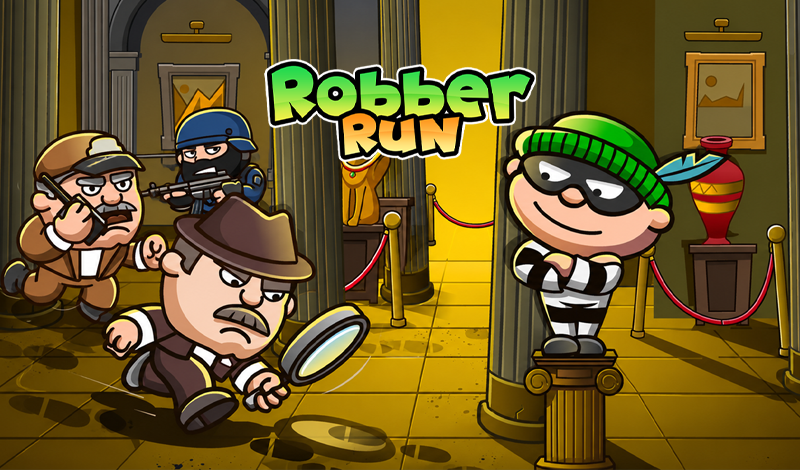
In Robber Run, the best move is often no move at all. Every building in this stealth puzzle game is a locked system of guards, camera arcs, and laser grids - and the player who watches long enough will see exactly how it opens.
The Building Tells You the Answer First
Most action games reward the player who moves fastest. Robber Run rewards the player who moves last. Guards follow recognizable patrol routes that repeat on a cycle. Cameras rotate between fixed angles with consistent timing. Lasers cover specific corridors in patterns that leave measurable gaps. None of this is hidden. All of it is visible from the moment you enter a room.
The design is not trying to trick you into failure. It is asking you to observe carefully before committing to anything. Players who rush in treat every obstacle as an emergency. Players who pause treat the same obstacles as a schedule - something to read, understand, and step around at the right moment. Robber Run is a game about the gap between those two approaches.
How to Work Through Each Mission
Each level in Robber Run presents a building with a target objective somewhere inside. The path to that objective runs through a combination of locked doors, guarded hallways, elevator shafts, and restricted areas protected by security cameras. Progress means identifying safe corridors, timing movements against patrol and camera cycles, and interacting with doors and objects at the right moment.
Completing the main objective is only part of the mission. Escape is equally important - reaching the target and then getting trapped on the way out is a genuine failure state in Robber Run. Players who scout the exit path before engaging the objective tend to finish missions more cleanly than those who plan the approach and improvise the retreat.
Controls
A / Left Arrow - move left
D / Right Arrow - move right
W / Up Arrow - interact with doors, objects, and elevators
Why Patience Earns Better Results Than Speed
The mechanics of Robber Run naturally slow players down over the first few levels and then reward that adjustment. Rushing through a camera's coverage window feels possible until it isn't. Following a guard too closely works until the patrol loop completes unexpectedly. The game teaches timing through failure, and each reset is short enough that the lesson lands rather than punishes.
Robber Run also surfaces hidden routes for players who look beyond the obvious path. Some corridors appear blocked but connect to areas that bypass the heaviest security. Some objects interact with security systems in ways the level does not announce directly. Players who treat the environment as a set of clues rather than a set of obstacles find multiple valid solutions where others see only one.
The Bonus Loot That Makes Risk Worth Calculating
Beyond the mission objective, each building in Robber Run contains valuables that require additional risk to collect. Bonus loot is positioned in guarded areas, behind secondary security, or past routes that demand tighter timing than the direct path to the objective. Taking the optional risk requires a more precise read of the environment and a longer time investment in observation.
This optional layer gives Robber Run genuine replay value. Players who complete the objective cleanly can return to the same level with a different priority - testing whether the bonus collection route they spotted but did not attempt is actually viable. The building stays the same. The player's understanding of it grows.