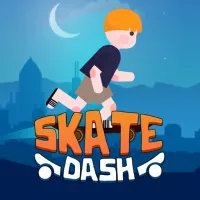
The safe line gets you to the end. The trophy line gets you the score worth bragging about. Skate Dash never makes you choose - but it always makes you decide.
Rolling Without Stopping
Skate Dash puts your skateboard on auto-pilot - constant forward motion through 2D stages packed with gaps, barriers, crates, and raised platforms. One input does everything: click to jump. The skill is not the jump itself. It is knowing exactly when the gap ahead actually needs one.
What separates Skate Dash from a standard obstacle-dodge game is spacing. Obstacles rarely arrive in isolation - they come in sequences where the gap between hazard one and hazard two determines whether a single jump clears both or whether you need a second input mid-air. Reading that spacing before you are committed to the first jump is the entire learning curve.
Two Lines Through Every Level
Trophies scatter across each stage, and here is the thing: the trophy line and the safe line are not the same line. Trophies often sit slightly above, slightly past, or slightly inside a hazard's danger zone - close enough that grabbing them requires a jump with less margin than the conservative route offers.
This creates a constant low-level decision running underneath every obstacle read. A clean run with zero trophies finishes the stage. A run that chases every trophy risks more crashes but produces a score that actually means something. Most players start on the safe line by instinct and gradually pull toward the trophy line as their obstacle-reading gets faster - which is exactly the progression Skate Dash is built to produce.
Where Runs Actually Fall Apart
Single obstacles are rarely the problem after the first few stages. Consecutive hazards are. A gap immediately followed by a tall barrier immediately followed by stacked crates compresses three decisions into a window where there is barely time to register the first jump's landing before the second one is due.
The fix is not faster reactions - it is pre-reading. By the time you are airborne over the first hazard in a sequence, your eyes should already be on the second one. Reacting to what is directly underneath the board is always one beat too late once sequences start stacking.
Controls
Click / Tap - jump
That's it. Everything else is timing and spacing.
Riding Longer, Scoring Higher
On a new stage, take the safe line first. Learn the hazard sequence and spacing without trophy pressure. Once the obstacle rhythm is familiar, the trophy line becomes a deliberate choice rather than a gamble.
Stacked crates need height, not just timing. A jump that clears a single gap cleanly often clips the top crate in a stack - the takeoff point matters as much as the timing. Jump slightly earlier than instinct suggests when crates are stacked tall.
The thing that changes everything: trophies positioned right after a hazard, not during it, are nearly free - the jump that clears the obstacle also reaches the trophy if your arc carries far enough. Trophies positioned inside a hazard's danger zone are the ones that actually cost you runs. Learn to tell the two apart at a glance.
Consecutive hazards reward committing to a rhythm, not individual precision. Once you can read a sequence as one pattern instead of three separate jumps, your success rate on repeated stages jumps dramatically - literally and figuratively.
Drop in at OhGames.io and find out how far Skate Dash lets you push the trophy line before the safe line starts looking smart again.