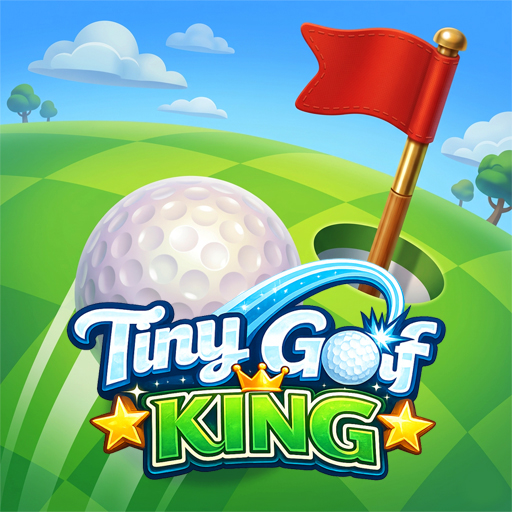
Tiny Golf King is a mini golf game where the strongest swing is almost never the correct one. Each course places slopes, walls, and sometimes moving obstacles between your ball and the cup - and every one of them rewards patience over power. The putt you actually need is almost always softer than what instinct tells you to hit. Getting good at Tiny Golf King means learning to distrust your first read of the hole.
The Physics That Punish Overconfidence
The moment most players overshoot their first putt in Tiny Golf King, something important clicks about how this game works. Power is a liability here, not a tool. A ball hit too hard skips past the target angle, rebounds off the wrong wall, and often ends up farther from the cup than it started. The physics reward subtlety in ways that keep surprising: slopes catch the ball mid-roll and redirect it well past where you aimed, moving obstacles block the exact gap that looked open when you set up the shot, and walls that seem like shortcuts become dead ends when the entry angle is even slightly off. The game is continuously teaching you to second-guess your swing before you take it.
How Each Hole Plays Out
Every hole in Tiny Golf King gives you a course to read before committing to any swing. Hold the mouse button and drag to set your aim direction and dial in the power - a short drag for a gentle touch, a longer drag for more force. Release to send the ball rolling. Your goal is to reach the cup in as few strokes as possible. Some holes are clean enough to clear in two well-placed shots; others require threading through a narrow corridor, using a wall rebound at a specific angle, or waiting out a moving obstacle before releasing at precisely the right moment. The hole count is what the scorecard sees. The strokes tell the real story.
Controls
Mouse (hold and drag) - aim the direction and set shot power
Mouse (release) - putt the ball
Wall Rebounds and the Shorter Route
One thing Tiny Golf King rewards over time is the discovery that the most direct path to the cup is rarely the fastest one. Wall rebounds, used correctly, cut across the course in ways a straight approach cannot reach. A ball angled at the left wall will travel across to a gap that a direct shot would have needed to navigate around the long way. Once you start treating every surface as a potential redirect rather than a boundary, the course layout stops looking like a problem and starts looking like a menu of options. Some holes are genuinely designed around this - the only sub-par route runs through a specific rebound that a straight approach can't use at all.
The Patience That Builds a Score
Tiny Golf King rewards observation more than hand speed. Before any swing, the smart move is to watch - not just where the hole is, but how the obstacles are moving, which slopes are going to carry the ball sideways when the shot looks straight, and which walls offer the correct rebound angle for the pin position. The difference between finishing a hole in two strokes and finishing it in four is almost always the ten seconds of study that came before the first putt. The swing itself is the simple part once you understand where it needs to go. The game is really a test of how long you're willing to look before you commit.
The patience carries over to whatever comes next. Golf Hit and Golf Orbit bring the same quiet problem-solving energy if this style of precision clicked for you - different setups, same principle: the best shot is the one you thought through before you took it.