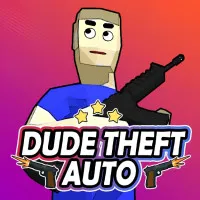
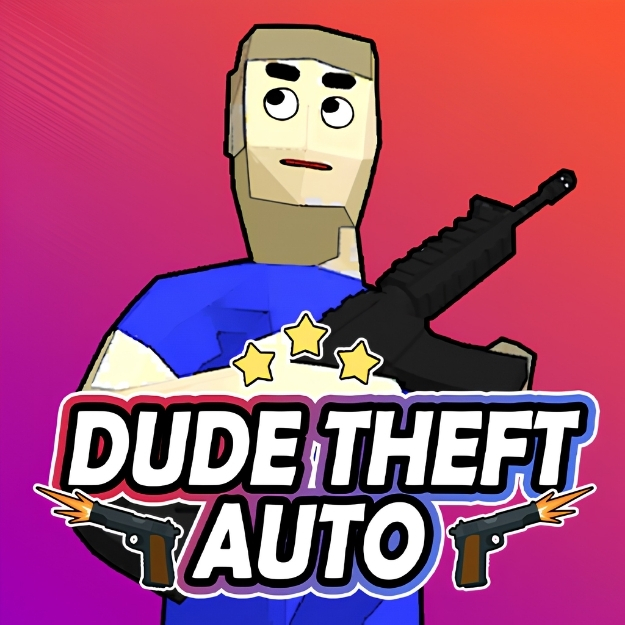
Dude Theft Auto doesn't care what you planned to do. You arrive in the city with good intentions - maybe take a mission, maybe try the taxi job - and within two minutes you've stolen a car, outrun a police pursuit, and completely forgotten what you came here for. That's not a bug. That's the design.
When the Stars Become the Objective
Most open-world games treat wanted levels as punishment. The stars exist to redirect you back toward missions, to remind you there are rules. Dude Theft Auto has missions too - they arrive on your in-game phone, and some of them are genuinely worth doing. But the moment you clip a cop car and watch that first star light up, something shifts. Sirens. Backup. A chase that pulls you across four blocks before you shake them in an alley. By the time the pursuit ends, you're not checking your phone for the next assignment. You're calculating how to reach five stars.
The wanted system in Dude Theft Auto doesn't function as a deterrent. It functions as content - the most reliably exciting content in the sandbox.
What the City Is Actually Hiding
The open world extends further than the first few blocks suggest. Beyond the obvious car theft and street fights, there's a taxi service for when you want to drive legally, a bowling alley for when you want competition without collateral damage, and a weapon shop for when you want to be more deliberate about your chaos. Bank robbery missions add structure and real stakes - get in, locate the cash, get out before you're cornered. Dude Theft Auto moves between absurd comedy and high-tension chase sequences without announcing the transition. One minute you're bowling a strike. The next you've started something you can't stop.
The map isn't large, but density compensates for scale. Every block has something reactive - an NPC who fights back harder than expected, a vehicle with handling that surprises you on a corner, a ramp you didn't see until you were already airborne.
Controls
WASD / Arrow Keys - move on foot
Spacebar - jump and climb obstacles
Mouse - look around and aim
Left Click - shoot or attack
E - enter and exit vehicles
How the Physics Make Every Run Different
The ragdoll system in Dude Theft Auto isn't decoration. It changes how fights resolve, how crashes end, and how chases go sideways in ways you didn't plan for. A fistfight near a slope sends someone tumbling downhill. A car collision at the wrong angle sends you through the windshield instead of into a clean escape. The physics don't just make things look funny - they make identical setups play out differently each time.
This is what separates Dude Theft Auto from scripted action games where enemy behavior follows a pattern you can memorize. Here, the outcome of any confrontation depends partly on positioning, partly on timing, and partly on how the engine reads the collision. You learn the system well enough to work with it, but you never fully predict it.
Why the Missions Are Worth Doing
The phone missions range from quick delivery tasks to multi-step jobs that ask you to plan a route before committing. None of them lock you into a fixed path - you can abandon any mission and return to free roam without penalty. This makes the mission structure feel like options rather than obligations, which suits a sandbox that rewards improvisation over planning.
Finishing missions earns money for weapons and upgrades, giving the open world a light progression layer that doesn't interrupt the chaos but rewards players who want to build toward something more deliberate.
Jump in and see how long you last before the stars stack up -City Brawl keeps the street-level action going, andEscape Road City 2 brings its own chase-and-evade energy from a different angle.