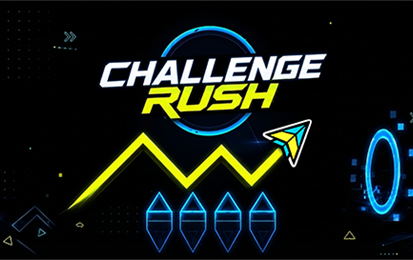
Challenge Rush is a rhythmplatformer with one principle running underneath every level: the music already knows where the obstacles are. Learn to hear it, and the stage starts to make sense before your eyes have caught up. Ignore it, and every run ends in the same places, for reasons that feel random but aren't.
The Music Is the Level Design
Every level in Challenge Rush is built around its track's BPM. Obstacle timing, portal placement, speed ramps - all of it is positioned to land on the beat. This isn't aesthetic decoration. It means that when you fail a section repeatedly, listening to the music will sometimes reveal the solution before another visual attempt does. Spikes arrive on the downbeat. Portals fire mid-phrase. The level isn't just an obstacle course. It's a musical score that happens to reset you when you miss a note. Most rhythm games add music to a movement challenge. Challenge Rush inverts that relationship - the movement challenge is constructed out of the music, from the opening bar to the finish.
Five Characters, One Stage, No Stable Instinct
Challenge Rush runs five distinct character types through portal transitions mid-level. The Cube jumps with a single tap - predictable, classic, reliable. The Ship rises while held and falls when released, demanding a constant feel for vertical momentum. The Ball rolls along surfaces and flips gravity with each input, turning every platform into two possible orientations. The UFO thrusts upward in short bursts, hovering at the mercy of timing and patience. The Wave traces a continuous zigzag through narrow corridors, never fully stopping. No single level stays in one character form. Portals switch you between modes mid-run, and the challenge compounds because the instinct you've built for one character is exactly the wrong reflex for the next one the level sends you into.
Controls
Left Mouse Button / Spacebar / Up Arrow Key - jump, thrust, or activate (action depends on current character)
Hold input - rise continuously in Ship mode
Practice Mode - place custom checkpoints to learn sections before attempting full Normal Mode runs
Normal Mode vs Practice Mode: Two Ways to Learn the Same Wall
Normal Mode in Challenge Rush doesn't offer checkpoints. One collision sends you to the beginning - not the last safe zone, not the nearest platform, but the start. This is the game's core design decision, and it's intentional. The levels are built to be learned through repetition, not improvised past. Practice Mode exists for exactly that learning process: you place your own checkpoints wherever you want, run the section until the timing becomes natural, then take the lesson back to the full attempt. Both modes play through the same levels. The difference is what you're measuring - speed of completion in Normal Mode, or depth of understanding in Practice Mode. The players who eventually clear difficult stages cleanly have almost always spent time in both.
A Community-Built Game With No Finish Line
What separates Challenge Rush from most browser rhythm games is the level editor, and what makes the editor meaningful is how it's built. Every stage created in-game links to the track's BPM, which means the tools themselves guide obstacle placement onto the beat. Creators don't have to manually sync obstacles to music timing - the editor handles the alignment, leaving the creative work to layout and difficulty. Published levels are moderated before going live. The catalog is rated and searchable. Leaderboards track performance per-level, not just globally. The result is a game with technically infinite content, and that content improves as the community grows and the best-rated levels rise. The official levels exist to demonstrate what's possible. After that, the community takes over.
Free to play in any browser, no download -Geometry Dash Lite brings the same single-tap rhythm challenge with its own soundtrack, andStickman Climb 3D offers a different kind of precision platforming when you need to switch gears.