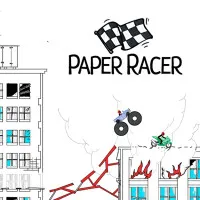
Paper Racer does not generate its tracks. Every course you race on was drawn by a person - sketched on a digital canvas, playtested, and published for others to ride. The cliff that sent you flying after the third loop was a deliberate design choice made by whoever created that track. The teleporter at the end of the gravity zone didn't happen by accident. Someone put it there.
Every Track Is Someone's Idea
The dominant experience in most racing games is a designer's vision of what a course should be - smooth, intentional, tested for fairness. Paper Racer opens that process to everyone. The community track catalog contains thousands of courses spanning every skill level and design philosophy. Some creators build smooth, technically satisfying routes that reward balance and momentum management. Others build traps - courses designed to look solvable until a specific moment reveals the joke. A few build genuinely inventive circuits that use gravity zones, teleporters, and interactive hazards in combinations that feel genuinely surprising. Racing through the community catalog is less like following a curated progression and more like reading through someone's collected ideas about what a track can be.
How Paper Racer Works
The core mechanic is physics-based motorcycle trial racing: guide your vehicle from start to finish without flipping over, collecting stars scattered across each course along the way. Tracks are built from hand-drawn terrain that looks like it was sketched on notebook paper, giving every course a visual identity that matches the game's creative tone. Balance and lean timing matter more than raw speed - hitting a ramp at the wrong angle sends the bike into an unrecoverable flip, while a perfectly timed lean during a jump lands clean and maintains momentum. Checkpoints break longer courses into manageable sections, and collecting stars rewards thorough track exploration rather than just reaching the finish. The career mode offers over a hundred official tracks that introduce the physics system gradually before the community catalog opens up the real variety.
Controls
Up Arrow / W - accelerate
Down Arrow / S - brake or reverse
Left Arrow / A - lean backward
Right Arrow / D - lean forward
Six Vehicles, Thousands of Interpretations
Paper Racer offers six vehicles - motorbike, moped, mini ATV, monster truck, lunar rover, and formula car - each with different speed, handling, and stability characteristics that change how the same track feels. A track that flows naturally on the motorbike becomes a careful balance act on the moped and a momentum puzzle on the monster truck. Switching vehicles on a course you've already attempted reveals design details that weren't visible the first time through. Some community tracks are built with a specific vehicle in mind, which becomes apparent mid-run when the physics suddenly make much more sense. Discovering which vehicle a creator optimized for is its own small puzzle embedded in the track.
When You Build the Course Yourself
The track editor gives every player the same tools that the community catalog's creators used: draw terrain freehand, add teleporters, configure gravity zones, place weapons and interactive hazards, then test the result in real time. Courses can be shared publicly, which means a track you built is potentially racing in front of strangers within minutes of publishing. The feedback loop between building and testing in Paper Racer is immediate - draw a ramp, flip into the editor, launch the bike at it, adjust. That speed from idea to rideable course makes the creative side genuinely accessible, not just a feature listed in the description.
Free to play, no install needed - find something in the community catalog worth finishing. Drive Mad keeps the physics challenge alive with terrain that fights back, andTrack Dash delivers a different kind of road-reading test for players who want to stay in motion.