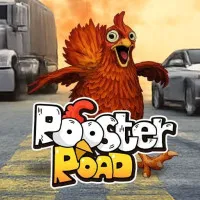
Rooster Road is a free multiplayer arcade survival game where you guide a rooster across an endless highway filled with cars, trucks, and buses - holding to move forward, releasing to brake, and reading traffic patterns to survive longer than every other player on the road. The mechanic is simple. The execution is not.
Developed by AZGames.io and launched in May 2025, the game takes the familiar road-crossing premise and adds two things that change everything: real-time multiplayer and a control scheme built around restraint rather than speed. Most players discover within the first few runs that the rooster who hesitates longest at the right moment usually outlasts the one who dashes forward first.
How Rooster Road Works
Your rooster moves one tile forward while you hold the control button and steps back when you release it. The road never stops - traffic flows constantly, patterns shift without warning, and other live players share the same lanes, creating collisions and openings that no solo game could replicate.
Every run in Rooster Road is shaped by three variables working simultaneously:
Traffic timing - cars, trucks, and buses move at different speeds, forming brief gaps you need to read before committing
Other players - their positions block paths, create unintentional shields, or pull traffic attention in ways that help or hurt your run
Power-up placement - speed boosts, shrink effects, revival tokens, and acceleration pickups appear mid-road, often in spots that require a calculated detour to collect safely
The longer you survive, the faster and more unpredictable the traffic becomes. There's no finish line - only the question of how far your rooster gets before the road wins.
Power-Ups That Change the Run
Where Rooster Road separates itself from standard crossing games is how its power-up system creates genuine mid-run decisions rather than automatic pickups.
Each power-up does something mechanically distinct:
Speed boost - accelerates your movement tile rate, useful for bursting through a closing gap but risky in dense traffic
Shrink - reduces your hitbox temporarily, letting you slip through tighter vehicle gaps that would normally end your run
Acceleration - increases how quickly you respond to hold inputs, rewarding aggressive players who can handle faster movement
Revival - saves you from one collision, effectively giving your run a second life when traffic catches you off guard
The trade-off most players face is whether to chase a revival token sitting in a dangerous lane or preserve a clean run by ignoring it. After a few sessions, reading which power-ups are worth the detour becomes as important as reading the traffic itself.
Game Controls
Rooster Road uses a single-input control scheme that works on both desktop and mobile.
Hold Spacebar or Mouse Button - move forward one tile at a time
Release - slow down or step back
The hold-and-release mechanic is the core skill of the game. Unlike tap-based crossing games where each press commits you to a full step, holding gives you fine-grained control over your advance rate - which means you can inch forward into a gap, feel the timing, and pull back before a vehicle closes in.
Tips to Survive Longer in Rooster Road
Reflexes matter less than most new players expect. These habits extend runs significantly once they become instinctive:
Watch two lanes ahead, not one. Clearing the lane in front of you into another dangerous lane is a common early mistake. Always have an exit plan before you move.
Use other players as traffic indicators. If a player ahead of you gets hit, that lane just cycled through a dangerous pattern - wait a beat before following their path.
Shrink power-ups are highest priority in dense traffic. A reduced hitbox lets you thread gaps that would otherwise end your run instantly. Detour for shrink when traffic density is high.
Don't hold continuously. Holding non-stop moves you forward at a fixed rate regardless of what's coming. Pulsing your hold - advancing one tile, pausing, advancing again - gives you time to read each lane individually.
Revival tokens are worth one dangerous crossing. Calculate the risk honestly. If reaching a revival requires crossing two unpredictable lanes, the token rarely saves more runs than it costs.
The consistent trade-off in Rooster Road is between accumulating distance quickly and staying alive long enough for traffic to create natural openings. Aggressive players score impressive early distances but crash before the multiplier builds. Patient players who wait for clean gaps tend to outlast everyone else on the leaderboard - including the ones who started faster.
Rooster Road rewards the rooster who thinks before it crosses. Every lane is solvable. Every traffic pattern has a gap. The question is whether you can wait long enough to see it.