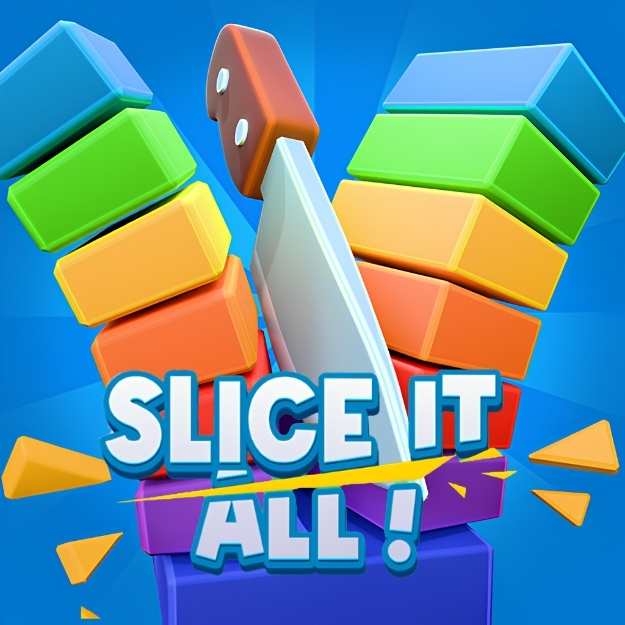
Slice it All keeps the blade in motion from the first second and never slows it down. Every tap doesn't steer the knife - it changes how it rotates, which determines the angle at which the blade arrives at the next sliceable surface. The knife keeps going regardless of what you do. Your job is to make sure it lands right each time.
What the Tap Is Actually Doing
It's easy to read Slice it All as a simple timing game: tap when the knife is lined up, slice the object, move on. But the tap isn't about position - it's about rotation. The knife travels forward automatically through each course. Each tap adjusts how it spins in the air, which changes the angle at which the blade contacts the next surface. A tap too early produces the wrong rotation and the blade arrives at the wrong angle. A tap too late misses the platform and ends the run. The difference between the two outcomes is often less than a single rotation, which is exactly why a well-timed landing feels earned rather than accidental.
How a Run Plays Out
Slice it All builds its stages around sequences of sliceable objects at varying heights and distances - fruit, pencils, furniture, and other everyday items placed in the blade's path. The knife launches forward and your task is to tap at the precise moments that keep it moving through the sequence cleanly. Each successful slice carries momentum into the next surface. A poor landing - where the blade arrives awkwardly, or misses the platform entirely - ends the run immediately. There's no recovery option. The knife either lands right or it doesn't, and the run's result follows directly from that.
Controls
Tap / Left Click - change the knife's rotation mid-air
Why the Short Format Keeps Pulling You Back
Slice it All is structured around brief attempts. A run lasts exactly as long as you can maintain the landing sequence - a few seconds when you're still working out the rotation rhythm, considerably longer once the timing starts to feel automatic. The brevity works in the game's favor: when a run ends, the reason is always legible. You went one half-rotation too far, or not quite far enough. The restart is instant, the correction is specific, and the next attempt is already underway before the frustration has anywhere to settle. That feedback loop - short run, clear cause, immediate retry - is what keeps a game this simple worth fifty attempts.
The Moment the Rotation Becomes a Rhythm
Slice it All changes in character once the tap timing stops being a deliberate calculation and starts becoming automatic. The taps that felt effortful and anxious early on take on a rhythmic quality - synced to the knife's spin cycle rather than reacting to where the next object appears. Once that shift happens, the blade arrives cleanly through several surfaces in a row, and the only thing left to manage is staying in the rhythm long enough to see how far the sequence can actually go before a momentary loss of focus breaks it.
When the rotation clicks, it clicks hard -Ragdoll Flip andSlice Master 3D bring the same need for landing precision from a different angle. Short run, clear failure point, pull of one more try - the loop stays the same.