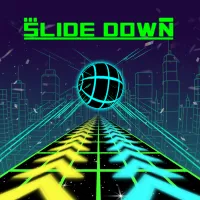
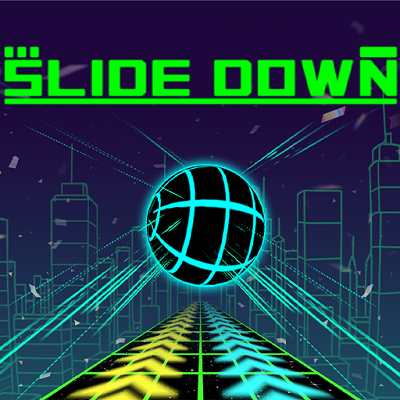
Slide Down strips away the jump button entirely - there's no leaping over obstacles, no double-tap escape route. Just a glowing ball on an elevated 3D track, gravity doing its job, and two directions to choose from before the edge arrives.
The Gravity You Can't Escape
The premise of Slide Down is deliberately minimal: steer left or right while a ball rolls forward on its own. No jumping, no mid-run power-ups, no second chances after an edge clip. The track unfolds ahead in neon rooftop segments, narrow platforms, sharp bends, sudden drop-offs and what ends the run isn't always the obstacle you failed to dodge. Sometimes it's a curve you leaned into half a second late. Gravity is constant, the track never slows, and the margin between a clean run and an instant restart is exactly as thin as the path you're rolling on.
How to Play Slide Down
Your ball enters the top of a neon rooftop course and keeps rolling. Red obstacle blocks interrupt the path regularly some centered, some offset to one side — and your job is to steer around them. The track divides into segments separated by speed boosters that activate automatically and push momentum up a level. Longer runs score higher, with global leaderboards tracking how far players rolled before losing control. There are no lives, no timer, no loading screens between attempts. You crash, you're back at the start, and the next run begins immediately.
Controls
Left Arrow / A - steer left
Right Arrow / D - steer right
Speed Boosters - triggered automatically, increase pace instantly
The Rooftop That Never Repeats
What keeps Slide Down engaging past the first few runs is the track layout variety. Every descent combines tunnels, narrow sections, tilted surfaces, and open platforms in configurations that vary enough to prevent pure memorization. Players chasing the leaderboard quickly discover that the best runs aren't about reacting faster — they're about reading the geometry two segments ahead and positioning the ball before the bend arrives. Early runs are reactive. Later runs start to feel like route reading.
Speed That Earns Its Reputation
Slide Down earns its difficulty through pace escalation rather than artificial complexity. Speed boosters don't feel like punishments — they're earned markers that reward survival. Each boost shrinks the reaction window and raises the required precision. Players who find this frustrating in early sessions tend to find it deeply satisfying once their steering instincts develop enough to keep pace. The game's difficulty directly mirrors how much of the track you've survived, which makes every extra segment feel like honest progress.