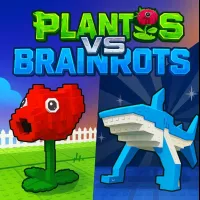
In Plants vs Brainrots, defeated enemies do not disappear - they become permanent trophies displayed in your garden, each one generating passive income long after the wave is over. That single mechanic reframes every battle from a defensive exercise into an investment decision.
When Your Enemies Start Working for You
Tower defense games typically treat defeated enemies as a score entry - they fall, you earn coins, you move on. Plants vs Brainrots holds onto them. Each Brainrot you defeat gets placed as a trophy in your garden, where it continues producing income passively for as long as it stands. The strength of your defense directly shapes the long-term value of your garden.
This creates a feedback loop that most tower defense games avoid. Strong lane coverage defeats more Brainrots, which fills your garden with more trophies, which generates more income between rounds, which funds stronger plants. Defense and economy are not separate systems running in parallel here - they are the same system expressed at different moments.
Planting a Defense That Pays for Itself
The battlefield runs across multiple lanes, with incoming Brainrots marching toward your garden from one side. Plants placed along each lane intercept them automatically. The seed deck gives you a selection of defenders with different attack ranges, firing rates, and special effects. Managing the deck means choosing not just raw damage output but positioning logic - which plants guard which lanes, and how to respond when an early wave overwhelms a lightly defended row.
The economy runs in both directions. Defeated Brainrots drop coins that fund plant upgrades and replacements. Weak defenders can be swapped mid-wave for stronger variants, but timing matters. Letting a lane go undefended costs you both the round and the passive trophy income those Brainrots would have generated. The game rewards players who plan several waves ahead rather than reacting to each one independently.
Controls
Mouse - place plants, open shop, manage upgrades
WASD / Arrow Keys - move character
E - interact with objects
1 - shoved action
2 - bit action
Spacebar - jump
Lane Strategy and What Actually Wins Rounds
The most durable strategies in Plants vs Brainrots balance coverage with income maintenance. Filling every available slot with mid-tier plants creates consistent early defense but slows the upgrade path. Leaving some slots for higher-yield plants - funded by early Brainrot trophies - produces better results over longer sessions. The most effective setups pair stun plants near the front of each lane with high-damage attackers behind them, giving damage dealers maximum time against slowed targets.
Area-effect plants handle clustered waves that overwhelm single-target defenders, while income-focused plants near the back generate coins passively between combat moments. Understanding which plant types counter which Brainrot behaviors is the puzzle that carries experienced players through the harder waves.
The Loop That Makes the Garden Worth Defending
What makes Plants vs Brainrots worth returning to across multiple sessions is how its progression compounds. Each run builds on the last - better plants, stronger positioning knowledge, a fuller trophy garden generating more baseline income per round. The meme-driven humor and Italian Brainrot flavor keep the tone light and irreverent, but the strategy layer underneath is genuinely deep for a browser-based tower defense experience.
The Roblox-inspired visual style attracts players already familiar with the brainrot universe, but the lane defense mechanics stand on their own. Even players with no attachment to the meme culture will find a well-structured strategy game that rewards planning and adapts its challenge as your garden grows.