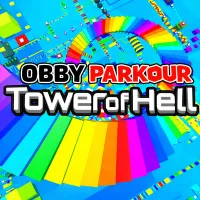
Some maps in Obby Parkour: Tower of Hell include checkpoints. Others don't. The no-checkpoint runs are where the game shifts from a reflex test into something closer to a memory challenge. You learn each section not by clearing it but by failing it enough times that the pattern becomes automatic. Spinning bars have a rhythm. Moving platforms have timing windows. Narrow ledges have safe landing zones. The game doesn't tell you any of this - it shows you by letting you fall until you stop falling.
When the Safety Net Disappears
The checkpoint-free maps in Obby Parkour: Tower of Hell function as a focus mechanism. Most browser platformers train players to treat mistakes as minor setbacks - you respawn nearby, you retry the segment, you eventually clear it through repetition. Remove that structure and the entire mental model of how you play changes. You can no longer afford to rush a platform just to see whether the timing works. The cost of being wrong is too high.
This creates a very specific kind of attention that most games never demand. Not patience in the sense of waiting - patience in the sense of being fully present for 10 consecutive seconds without letting your momentum override your judgment. The Tower of Hell design philosophy is built entirely on whether players can sustain that state long enough to reach the top.
Understanding the Tower Structure
The vertical tower layout is deliberate. Progress in Obby Parkour: Tower of Hell is always measured upward, which gives every failure the same visual weight - you can see exactly how far you've fallen and exactly how far you still need to go. Levels stack floating platforms, moving traps, spinning bars, lava floors, and disappearing tiles across distinct vertical sections. Each section introduces a new hazard combination rather than escalating raw speed, which means pattern recognition matters more than reflex speed as you climb.
Some maps include checkpoints at structural transitions, which allows you to approach difficult segments more aggressively. The game never tells you in advance which type of map you're entering. Learning which runs have safety nets and which don't is part of adapting your playstyle session by session.
Controls
W / A / S / D - move
Left Shift - sprint
Mouse - adjust camera angle
Tab - pause
Themed Challenges and Mode Variety
Beyond the standard tower format, Obby Parkour: Tower of Hell includes several alternate challenge modes that reuse the obby vocabulary in completely different contexts. Prison escape sequences redesign the obstacle logic around narrative settings rather than abstract tower levels, giving each section a thematic identity that changes how you read the environment. Reaction-based modes like Red Light, Green Light introduce a timing constraint that has nothing to do with platformer precision - you're being tested on stopping, not moving.
Each mode forces you to unlearn the rhythm you built in the previous one. The sprint key that helps on wide platforms becomes a liability on narrow ones. The camera habit that works in open sections creates blind spots in tight corridors. Obby Parkour: Tower of Hell isn't a single skill, it's several of them packaged as one game.
The Mental Shift Between Modes
Players who come from checkpoint-heavy platformers will fail more in the early runs here than their skill level actually warrants. The instinct to move fast and use checkpoints as a reset mechanism is deeply ingrained - and the game deliberately gives you just enough checkpoint-enabled maps early on to let that instinct calcify before taking it away. The adjustment period is real, but the skill that comes out the other side - deliberate, patient, precise platforming - carries over to every other obstacle game you play after it.