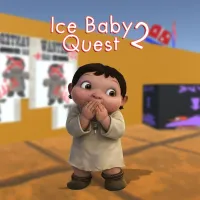
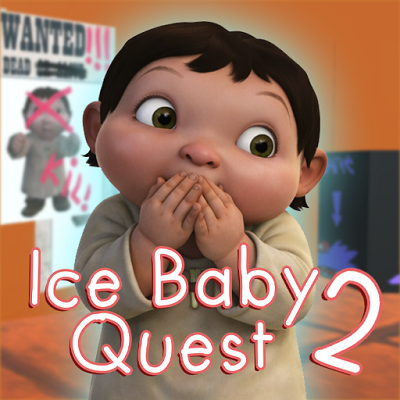
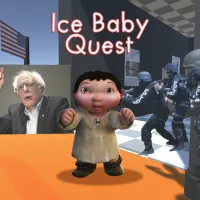
Ice Baby Quest 2 punishes the player who tries to play it normally. Speed won't help here, and logic actively works against you. Every meaningful step forward comes from stopping, reading, and accepting that the rules you're used to don't apply anymore.
Why Conversations Do the Work Reflex Can't
Most games reward quick movement and fast decisions. Ice Baby Quest 2 rewards the opposite. The world is built around NPCs who speak in meme logic and offer items through exchanges that follow no recognizable pattern. You can't fight your way to progress, and you can't run past the dialogue. The characters you'd normally skip are the ones holding every key, code, and item you need. Players who treat this like a standard adventure game stall immediately. Players who slow down and engage with the absurdity find that the game has an internal logic - it just doesn't care whether that logic makes sense.
How to Play Ice Baby Quest 2
Explore the 3D environment from a first-person perspective and interact with as much as you can reach. Hidden dollar bills scattered across the map unlock essential tools, so curiosity has direct mechanical value. NPCs trade cryptic items that feed into multi-step exchange chains, each one leading toward the next piece of the puzzle. Keypad-locked areas require codes found through dialogue or environmental clues. A secondary low-gravity zone called Marsageddon expands the map with altered physics that change how movement and traversal work. Some of the game's intentional design quirks operate as shortcuts for players who think to test them.
Controls
WASD / Arrow Keys - move
Mouse - look around
Left Click - interact with NPCs and objects
Spacebar - jump
Left Shift - sprint
What the Sequel Added Over the First Game
Ice Baby Quest 2 doesn't try to fix the original - it extends it into larger territory. Dialogue trees are substantially longer, with more character interactions that deepen the absurd narrative. The Marsageddon environment introduces alien geometry and lower gravity, making traversal feel distinctly different from the main map. Fetch quest chains involve more steps and more characters, so the trading logic gets weirder before it resolves. A replay mode modifies scenarios on second runs, giving players who've already completed the game altered quest structures to work through. Intentional glitches from the original are preserved and expanded as design features rather than bugs.
The Marsageddon Shift and Meta Design
The game's self-awareness runs deeper than its jokes. Ice Baby Quest 2 deliberately uses the conventions of first-person adventure games against the player's expectations - areas that look important aren't, items that seem irrelevant matter enormously, and NPCs who appear decorative are central to progress. Marsageddon takes this further by introducing a physically different zone that requires learning a new movement vocabulary mid-game. The meta design philosophy is consistent throughout: the game knows you've played games before, and it uses that familiarity as the source of almost every joke and almost every obstacle.
Open and see what you find -Ice Baby Quest sets the same tone with the original absurd quest, andSchoolBoy Runaway rewards the same kind of careful, deliberate attention over fast reaction.