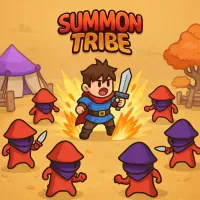
In Summon Tribe, the real crisis is never the wave coming at you. It's the board behind you that's completely full.
This casual merge and defense game places you in a role that feels simple at the start: combine identical units to create stronger ones and hold back waves of incoming enemies. The twist arrives when you realize that the space you have to work with is fixed. Every slot counts, every unit takes up room, and the moment your board fills with mid-tier units that can't merge and can't be discarded without consequence, the defense starts cracking.
The Board Is Already Half-Full
Most merge games give you the feeling of infinite possibility. Summon Tribe works the other way around - it gives you a constrained grid and asks you to manage scarcity. Early game, there's room to experiment: drop a trap here, a turret there, merge two facilities when they level-match. Mid game, the board gets tight. Late game, every new unit placement forces a choice about what to remove or sacrifice.
This spatial constraint is what separates Summon Tribe from a straightforward tower defense. The merging isn't just an upgrade system - it's a space management problem. Keeping three low-tier units alive "just in case" is often worse than sacrificing one to open a slot for a high-tier merge that could actually stop the next wave.
How to Play Summon Tribe
Enemies approach in waves, and your goal is to prevent any from breaking through your defense line. You place and upgrade facilities, traps, and turrets within the available grid space. Each turn, you can choose to merge two same-level units to produce a stronger one, place a new unit you've earned, or activate a skill from your skill selection pool.
Between waves, the game gives you a brief window to reorganize. This is when good players rethink the board layout - not just react to it. Summon Tribe rewards players who plan two or three waves ahead, not just players who merge whatever pairs up next.
Controls
Mouse Click - select units, traps, and facilities
Mouse Drag - reposition units within the grid
Mouse Click on merge prompt - combine matching level units
Why Merging at the Wrong Moment Costs You
The temptation in Summon Tribe is to merge everything as fast as possible. The problem is that merging a turret on the front line while a wave is incoming leaves that slot momentarily empty. Enemies that reach an undefended position deal damage that scales as the waves grow harder. Timing your merges to dead moments between waves - not during them - is a skill that takes a few sessions to develop.
The skill selection system adds another layer. After certain waves, you pick from a random selection of passive or active boosts - extra damage, faster trap recharge, additional carry capacity. Some of these are situational; others are broadly strong. Learning which skills synergize with your current board layout takes time, but it's what allows runs to extend from five waves to fifteen.
The Long Game Behind the Casual Surface
Summon Tribe presents itself as idle-friendly - you can step back and let defenses run for a bit. But the ceiling is higher than that implies. Extended survival comes from active reshaping of the board as enemy compositions shift. Some waves hit the center hard; others spread wide. A board optimized for one pattern may not handle the next.
The satisfaction of Summon Tribe isn't the individual merge - it's the moment when the board clicks into a configuration that handles whatever comes next without any intervention. Getting there requires more deliberate planning than the casual framing suggests.
No install, jump straight in -Duo Defense andSoyjak Siege bring the same defense-building instinct with their own twist on the formula.