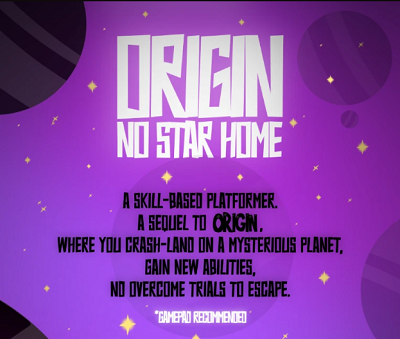
Origin: No Star Home gives you one mechanic at a time and asks you to master it before the level ends. Brokellusion's puzzle platformer is built around constraint - each stage introduces a single environmental rule, uses it to construct a challenge, and then moves on. The alien is lost, and so is the player, which is exactly how this game is designed to feel.
One Rule at a Time, One Way Out
Most puzzle games layer complexity over time - stacking mechanics on top of each other until the solution space becomes wide enough to lose yourself in. Origin: No Star Home does the opposite. Each level introduces exactly one environmental rule and asks you to understand it fully before progression is possible. Some levels hinge on platform timing. Others on object interaction sequences. A few on movement constraints that feel counterintuitive until the moment they click.
This design philosophy - teach one thing, test one thing, move on - keeps pacing tight without sacrificing depth. You're never overwhelmed, but you're never coasting either. Every level has a discoverable logic, and finding it is the entire satisfaction of the game.
How to Play Origin: No Star Home
You guide a small alien through a series of compact platform puzzle stages. The goal in each level is to reach the exit. Between you and that exit is a combination of platforms, interactive elements, and environmental rules that make the direct path impossible without solving what's in front of you.
There's no health bar and no fail state beyond needing to retry a puzzle. Origin: No Star Home rewards experimentation - when you try something and it fails, the failure itself narrows down what the solution must be. The game doesn't tell you what to do; it shows you what doesn't work until only the right answer remains.
The alien character is deliberately simple in ability: move left, right, and jump. Solutions come from reading the environment, not from unlocking special moves. Every stage is solvable with the tools you already have from the first second.
Controls
Arrow Keys / WASD - move left, right, and jump
Enter - start the game or confirm selections
R - reload the current level
M - mute audio
Q - return to the menu
What Makes Each Puzzle Land
The level design in Origin: No Star Home achieves something rare in browser puzzle games: the solution is always fair. When you figure out what a level wants, the answer doesn't feel arbitrary - it feels like something you were being guided toward the whole time.
This is the result of deliberate environmental scaffolding. The first time a new mechanic appears, it's introduced in a low-pressure context where experimentation is easy. By the time the game challenges you with that mechanic under tighter conditions, you've already internalized how it works. The difficulty curve feels invisible because the learning has already happened.
Origin: No Star Home carries the design voice consistent with Brokellusion's catalog: clean visual environments, intuitive physics, and a refusal to explain more than necessary. This is a game that treats players as capable of figuring things out, which makes the moments when you do feel disproportionately satisfying.
Calm Pacing, Genuine Depth
Origin: No Star Home presents itself as a relaxed experience and delivers on that tone - but the calm pacing disguises how carefully each level is constructed. Later stages layer the single-mechanic rule over geometry that requires more precise execution, raising difficulty without changing the underlying challenge type.
This escalation is patient. Players who reach later levels having fully understood the earlier mechanics find the harder stages feel earned rather than sudden. The game never introduces something unfair - it only asks you to apply what it's already shown you, in a context that requires you to apply it correctly.
No install, jump in now - Bounce Path and Vex Try to Fly keep the precision platforming energy going from different angles.