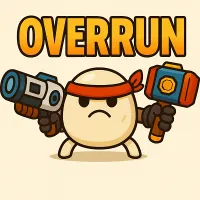
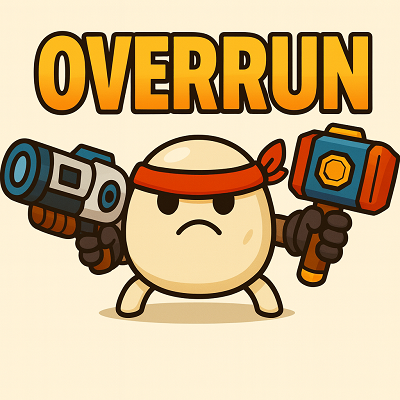
Overrun removes one variable from the survival equation entirely - your weapon fires itself. With auto-fire handling every shot, the only input left is movement, and that shift transforms what looks like a shooter into something closer to a positioning puzzle. Enemy swarms close in from every angle, and surviving isn't about shooting faster. It's about never being where the cluster is about to form.
When Moving Is the Only Weapon
The auto-fire mechanic in Overrun is not a convenience feature - it's the design. Most survival shooters split your attention between aiming and positioning, which creates a rhythm of aim-fire-dodge. Overrun removes the aim-fire half. Your hero fires constantly in all directions, and damage is largely out of your hands. What you control is where you stand, which gaps you open up by crossing the arena, and which escape routes you protect by staying out of corners. At medium density waves, almost any position works. At high density waves with elite enemies moving unpredictably, the only surviving tactic is a movement pattern that keeps gaps open long enough for your auto-fire to work through the crowd.
How the Survival Loop Escalates
Overrun works in waves with brief pickup windows between them. Each wave increases enemy count and density, which progressively narrows the safe zones available for movement. At the end of each wave, upgrade pickups appear in the arena - you collect them by moving through them, which means even the upgrade phase has a spatial component. The upgrades you choose between waves shape how long each subsequent run lasts: attack spread changes which directions your auto-fire covers most heavily, damage boosts accelerate crowd clearing, and ability chains create compound effects that only pay off once you've built enough synergy to trigger them together. By late game, elite enemies with unpredictable movement paths break whatever rotation pattern you've settled into, forcing reactive repositioning instead of planned routes.
Controls
WASD / Arrow Keys - move across the arena
Mouse - alternative movement direction (cursor-based)
Upgrade Priorities That Extend Runs
Early upgrades in Overrun should prioritize damage output, not coverage. A concentrated attack that clears enemies fast creates more breathing room than a wide spread that damages everything lightly. Side-shifting during dense waves - moving perpendicular to the swarm rather than directly away from it - is more effective than retreating, because retreating gives enemies behind you a free approach angle. Ability synergy becomes the focus by mid-run: selecting upgrades that interact, such as damage multipliers that activate during ability cooldowns, scales exponentially while single-stat upgrades flatten out. Safe rotation paths are the endgame skill - finding a repeatable movement loop around the arena perimeter that keeps no corner blocked for too long.
What Late Game Actually Tests
The early waves of Overrun are forgiving enough that almost any movement pattern survives. Late game removes that margin. Elite enemies choose movement paths that cut off the most obvious escape routes, which means your standard rotation stops working just as the arena feels the most crowded. The game tests whether your movement instincts have actually developed or whether you've been coasting on the early upgrade curve. Players who survive deep into late game are the ones who internalized positioning as a reflex rather than a conscious decision - because by the time elite enemies appear, there isn't time to think through each move. The auto-fire was always handling your offense. Late game proves whether you had a real defense.
Jump in and see how long your positioning holds -Undead Invasion andsurvival games keep the same wave-pressure energy going.